Modern Day Warfare
The character of warfare in the 21st century has undergone a fundamental transformation. Moving away from the industrial-age reliance on mass and clear territorial boundaries, modern conflict has evolved into a fluid, data-centric, and multi-dimensional paradigm. War is no longer strictly defined by the clash of conventional standing armies on a physical battlefield; it is now an integrated struggle for systemic dominance, cognitive influence, and structural resilience.
The blurring lines between combatants and civilians, combined with the rapid acceleration of technological innovation, have given rise to several distinct but overlapping types of modern warfare.
1. Asymmetric Warfare Asymmetric warfare describes a conflict between belligerents whose relative military power, strategy, or tactics differ significantly. Typically, this pits conventional state armies against Violent Non-State Actors (VNSAs) such as insurgents, terrorists, or resistance militias.
Because weaker forces cannot match the technological or numerical superiority of a nation-state, they attempt to offset their deficiencies by avoiding the enemy’s strengths and exploiting their vulnerabilities. A major trend in modern asymmetric conflict is the shift from “solid warfare” (focused on territorial conquest and control) to “liquid warfare” (focused on dismantling enemy networks and targeting infrastructure far from the battlefield). The democratization of technology, particularly Unmanned Aerial Systems (UAS) and drones, has provided non-state actors with precision-strike and surveillance capabilities that were once exclusively reserved for state militaries.
2. Hybrid Warfare and the Gray Zone Hybrid warfare is the synchronized use of multiple instruments of power tailored to specific vulnerabilities across the full spectrum of societal functions to achieve synergistic effects. Hybrid actors utilize a synchronized package of tools known by the acronym MPECI: Military, Political, Economic, Civilian, and Informational.
This type of conflict primarily operates in the “Gray Zone”—a space of tension that exists between traditional concepts of peace and open war. By employing methods like economic coercion, political subversion, cyberattacks, and the deployment of proxy forces, hybrid actors aim to achieve strategic objectives while remaining below the threshold of open military conflict that would trigger a conventional international response.
3. Fifth-Generation Warfare (5GW) While earlier generations of warfare focused on manpower, firepower, maneuver, and insurgency, Fifth-Generation Warfare (5GW) represents a structural shift where the primary battlespace is the human mind.
5GW is defined by data-driven, non-kinetic military actions designed to exploit existing cognitive biases and create new ones. It relies heavily on perception management and information operations. Through the use of deepfakes, AI-driven misinformation, and social engineering, actors can “command the trend” on social media by using bot networks to artificially amplify propaganda. The nature of 5GW is intentionally concealed, creating an “attribution problem” where a conflict can be fought and won without a single bullet being fired or the target population even realizing a war is taking place.
4. Multi-Domain Operations (MDO) In the realm of conventional, large-scale combat, military doctrine has shifted toward Multi-Domain Operations (MDO). MDO is the combined arms employment of joint capabilities across all five operational domains: land, sea, air, space, and cyberspace.
The objective of MDO is to achieve “decision dominance,” allowing a commander to see, understand, and act faster than the adversary. This is facilitated by a network-centric construct often called the “Combat Cloud,” which integrates information, sensing, effects, and command grids into a unified theater. In this self-healing network, cross-domain synergy ensures that the destruction of an individual node (such as a single tank or aircraft) does not result in mission failure, as capabilities can be compensated for by assets in entirely different domains.
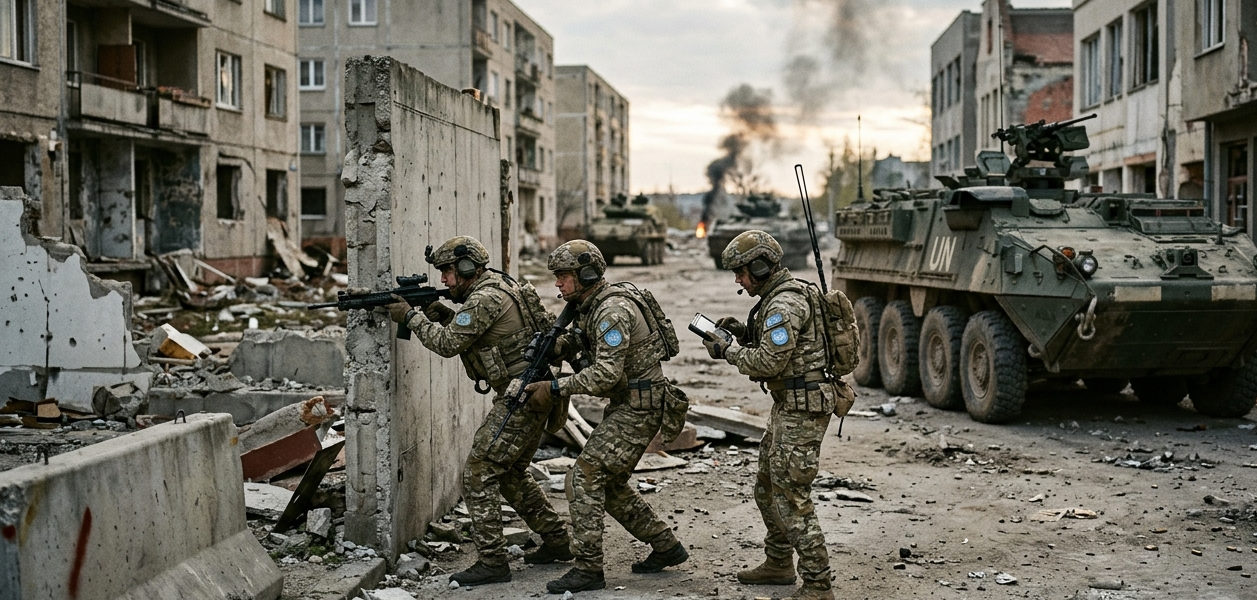
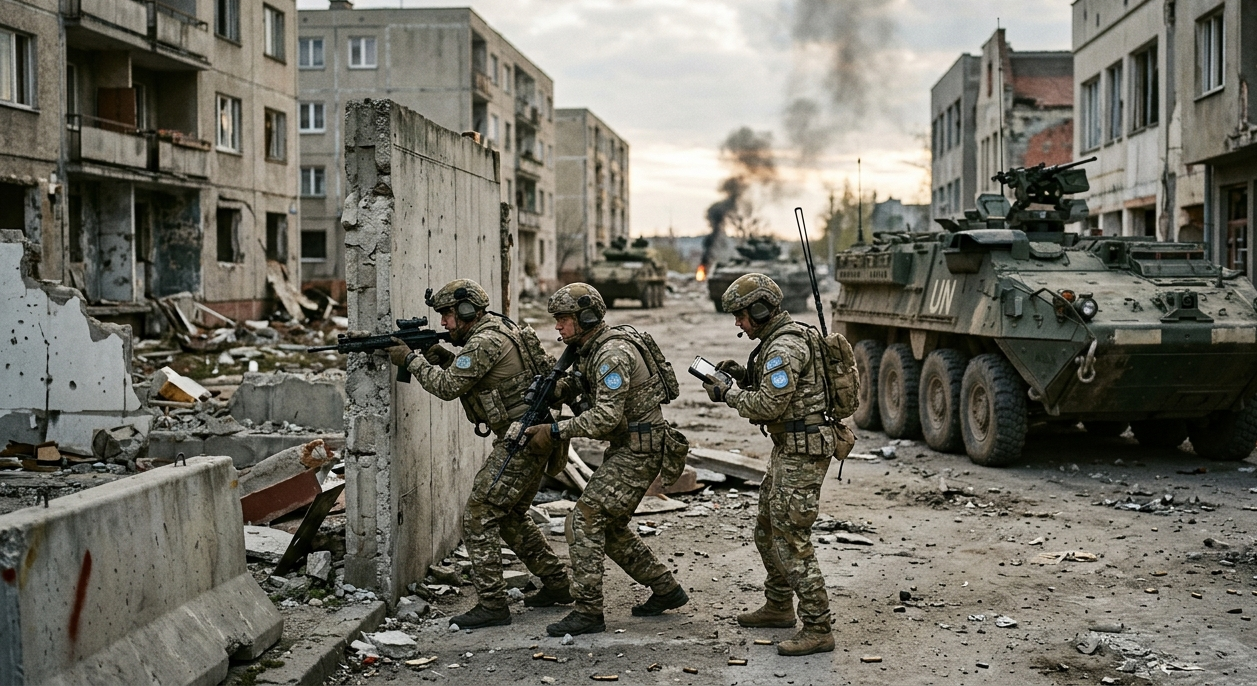
5. Urban Warfare Driven by global megatrends like exponential population growth, littoralization (coastal settlement), and unprecedented connectivity, the epicenter of modern conflict is increasingly shifting into megacities—urban centers with over 10 million inhabitants.
Megacities are the new “concrete jungles,” providing non-state armed groups with complex, three-dimensional terrain for cover and concealment. Urban warfare negates many high-tech military advantages, forcing advanced militaries to retrogress into brutal, physically taxing Close Quarters Battle (CQB). Furthermore, urban combat carries catastrophic humanitarian consequences, with civilians often accounting for 90% of casualties as fighting destroys essential infrastructure like water, sanitation, and hospitals.
6. Algorithmic and Autonomous Warfare The integration of Artificial Intelligence (AI) into the modern battlespace has initiated a race to automate and compress the “kill chain”—the process from intelligence gathering to a completed strike. AI platforms, such as the Maven Smart System, fuse satellite imagery, drone feeds, and radar data to recommend targets, reducing decision-making processes that once took hours or days down to mere seconds.
Simultaneously, the battlefield has seen the proliferation of AI-powered loitering munitions (kamikaze drones) capable of autonomously identifying, locking onto, and striking targets without human intervention. However, this “silicon battlespace” relies entirely on an invisible and highly vulnerable orbital layer. Over 70% of modern military operations depend on space-based satellite infrastructure for GPS navigation, precision timing, and communications, making space a critical and highly contested domain in modern conflict.
Hi, this is a comment.
To get started with moderating, editing, and deleting comments, please visit the Comments screen in the dashboard.
Commenter avatars come from Gravatar.